

YOU BELONG TO THE 21st-CENTURY

The Sustainable Economy
A sustainable economy is not a single economic activity. It is an interconnected system of economies, each performing a different function while strengthening the resilience and productive capacity of the community.
The Collaboration Economy
Connects and coordinates the other economies so that people, businesses, resources, knowledge, and productive capacity can work together. Rather than everyone trying to provide everything independently, participants specialize, collaborate, exchange, and support one another—creating a resilient economic ecosystem in which the success of each participant can strengthen the whole.
The Local Economy
Keeps production, jobs, knowledge, and economic value closer to the communities where people live. Local farmers, producers, artisans, businesses, and households provide more of what the community needs, reducing unnecessary dependence on distant and concentrated supply chains.
The Service Economy
Extends the useful life of what we already have through maintenance, repair, sharing, upgrading, and skilled services. Instead of replacing everything we own, local skills and businesses help preserve value, reduce waste, create jobs, and keep resources productive longer.
The Circular Economy
Designs waste out of the system by keeping products, materials, and resources in productive use for as long as possible. Products are designed to last, be repaired, reused, refurbished, repurposed, recycled, or returned safely to natural systems.
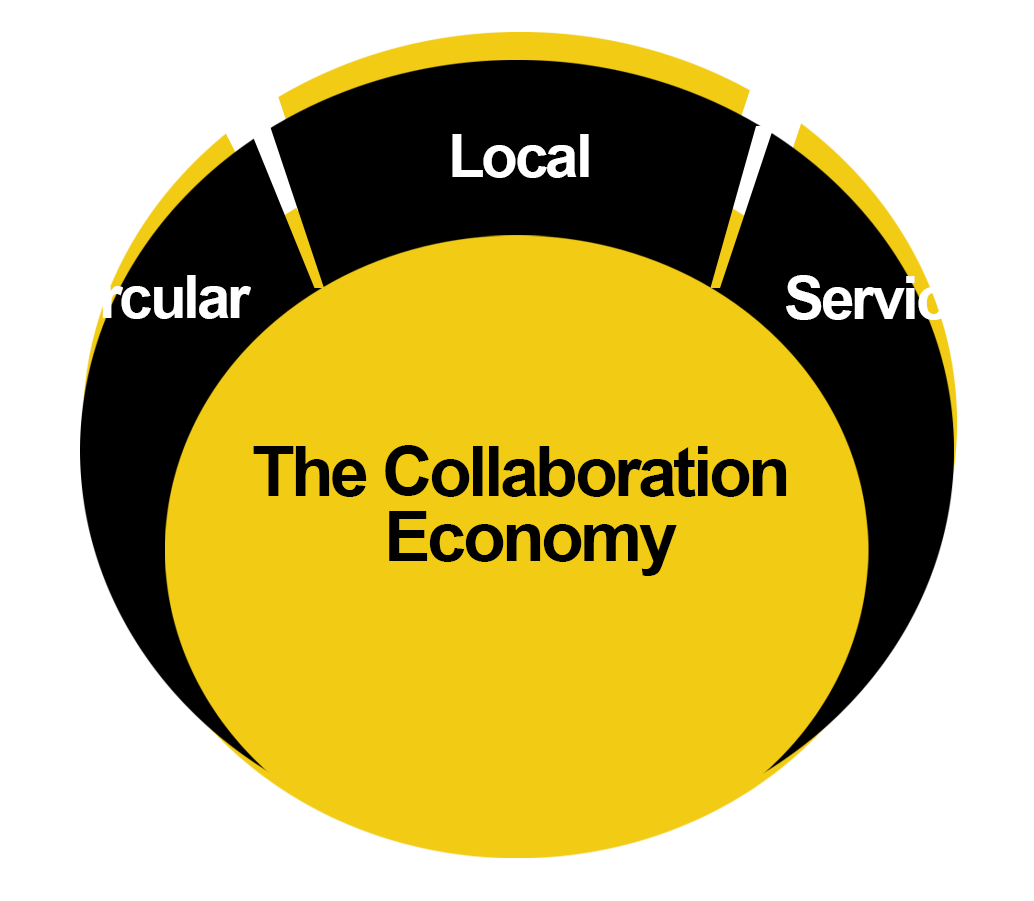
The Collaboration Economy is the organizing intelligence of the Sustainable Economy.
DESIGNED TO LAST
Patterns of Sustainable Systems

Sustainable systems share remarkably similar patterns. Healthy ecosystems, the planet, the human body, and strong communities depend on interdependence, collaboration, reciprocity, diversity, circulation, self-regulation, regeneration, and stewardship. Their parts are different, but they work together. Resources circulate. Feedback corrects imbalance. Diversity creates resilience. Damage is repaired. And each part contributes to the health of the whole.
Soloearth believes our communities and economies should be designed around these same principles.
Sustainability means building viable systems designed to last, in relationship with people and the planet.
MONEY SHOULD STRENGTHEN THE ECOSYSTEM
Regenerative Circulation
A sustainable economy needs circulation—but circulation alone is not enough. Circulation without retention creates fragility, while accumulation without circulation creates concentration. Healthy systems do both: they circulate resources while retaining enough to repair, adapt, invest, and grow.
Soloearth calls this Regenerative Circulation. Money spent within the local ecosystem should move through farmers, producers, workers, small businesses, and communities while also generating the capital needed to create new products, strengthen infrastructure, increase productive capacity, and build resilience. The goal is not maximum circulation. It is circulation that continually makes the whole system stronger.
Regenerative circulation is the process. Regenerative growth is the result.
REGENERATIVE GROWTH
Growth That Makes the System Stronger
Sustainable growth should leave behind more capacity than it consumes. It strengthens the foundations upon which future prosperity depends—healthy soil, clean water, productive infrastructure, resilient local businesses, human knowledge, innovation, and strong communities. Growth becomes regenerative when today's prosperity increases our ability to flourish tomorrow.
At Soloearth, we believe success should therefore be measured by more than how much we sell or how much financial wealth we create. The real test of growth is whether the people, communities, and planet that make prosperity possible become stronger because of it.

Principles of Healthy Ecosystems
Interdependence — Every part depends on the well-being of the others.
Collaboration — Different parts work together to strengthen the whole.
Reciprocity — Every healthy part both contributes and receives.
Circulation — Resources continually move through the system instead of remaining concentrated or stagnant.
Self-Regulation — Feedback and internal responsibility continually correct imbalance and maintain health.
Regeneration & Restoration — Healthy systems repair damage, replenish resources, and renew themselves.
Diversity — Different roles, capabilities, and participants create adaptability and resilience.
Adaptability — The system responds to changing conditions without losing its essential function.
Stewardship — Resources are used in ways that preserve the health and productive capacity of the whole.
Resilience as outcome — The system can absorb disruption, recover, and continue functioning.

solo/land
keep the rainforest.
We are losing more than 7 million hectares of tropical forest cover yearly.
Buy sustainable products. Here are sustainable sites you can consider for your next buy:
8000KICKS (Shoes & Backpack)
SYLVENNEWYORK (Shoes: Plant-based, bio-based, renewable, recycled, and organic vegan materials and components)
Minimize the consumption of beef, pork, and palm oil.
Buy beef and pork from local farms.
Try plant-based meat and cultivated meat.
Buy certified coffee.
Look for alternative, non-tropical hardwood.
Find companies that support sustainable products.
Reduce your carbon footprint.
Talk to your local outlets.
Get Political.

healthy oceans.
solo/oceans
Buy sustainable products. Buy locally (Chicken, etc.).
Minimize your single-use plastic. Buy less plastic.
Cut down on what you throw away.
Choose nontoxic chemicals (eco-friendly laundry detergent, etc.)
Fish responsibly.
Conserve water so excess runoff and wastewater will not flow into the ocean.
Reduce vehicle pollution.
Talk to your local outlets.
Get Political.
In the last 40 years, we have witnessed a devastating decline of over 40% in the marine life.

solo/sky
clean sky.
Since the middle of the 20th century, annual emissions from burning fossil fuels have increased from nearly 11 billion tons of carbon dioxide annually (since the 1960s) to an estimated 36.6 billion tons in 2022.
Buy sustainable products (latex paints, etc.)
Make your house more energy efficient. Reduce heating needs.
Walk, bike, carpool, take public transportation whenever possible.
Reduce, reuse, and recycle.
Use clean lawn and garden equipment.
Plant more trees in your home and community.
Choose pump sprays instead of aerosol sprays.
Choose low-volatile organic compound (VOC) products.
Make a green choice when buying a new car.
Support Eco-Friendly Products.
Talk to your local outlets.
Get Political.